#include <ClusterSequencePassiveArea.hh>
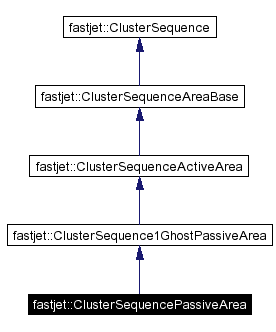
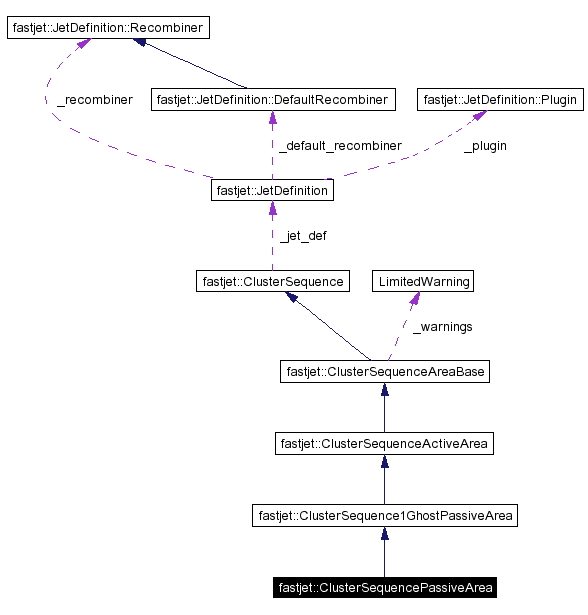
Inheritance diagram for fastjet::ClusterSequencePassiveArea:
Public Member Functions | |
| template<class L> | ClusterSequencePassiveArea (const std::vector< L > &pseudojets, const JetDefinition &jet_def, const GhostedAreaSpec &area_spec, const bool &writeout_combinations=false) |
| constructor based on JetDefinition and PassiveAreaSpec | |
| virtual double | empty_area (const RangeDefinition &range) const |
| return an empty area that's appropriate to the passive area determination carried out | |
Private Member Functions | |
| void | _initialise_and_run_PA (const JetDefinition &jet_def, const GhostedAreaSpec &area_spec, const bool &writeout_combinations=false) |
| global routine for initialising and running a passive area that is correct in general, but that chooses an optimal approach for various special cases. | |
Figure out what to do about seeds later...)
Definition at line 48 of file ClusterSequencePassiveArea.hh.
|
||||||||||||||||||||||||
|
constructor based on JetDefinition and PassiveAreaSpec
Definition at line 76 of file ClusterSequencePassiveArea.hh.
00079                                      {
00080
00081   // transfer the initial jets (type L) into our own array
00082   _transfer_input_jets(pseudojets);
00083
00084   // run the clustering for passive areas
00085   _initialise_and_run_PA(jet_def, area_spec, writeout_combinations);
00086
00087 }
|
|
||||||||||||||||
|
global routine for initialising and running a passive area that is correct in general, but that chooses an optimal approach for various special cases.
Definition at line 43 of file ClusterSequencePassiveArea.cc. References fastjet::ClusterSequenceActiveArea::_average_area, fastjet::ClusterSequenceActiveArea::_average_area_4vector, fastjet::ClusterSequence::_history, fastjet::ClusterSequence1GhostPassiveArea::_initialise_and_run_1GPA(), fastjet::ClusterSequenceActiveArea::_initialise_and_run_AA(), fastjet::ClusterSequence::_jet_def, fastjet::ClusterSequence::_jets, fastjet::ClusterSequenceActiveArea::_resize_and_zero_AA(), fastjet::antikt_algorithm, fastjet::ClusterSequenceVoronoiArea::area(), fastjet::ClusterSequenceVoronoiArea::area_4vector(), fastjet::cambridge_algorithm, fastjet::cambridge_for_passive_algorithm, fastjet::ClusterSequence::Invalid, fastjet::JetDefinition::jet_algorithm(), fastjet::kt_algorithm, fastjet::GhostedAreaSpec::mean_ghost_kt(), fastjet::JetDefinition::plugin(), fastjet::plugin_algorithm, fastjet::JetDefinition::set_extra_param(), fastjet::JetDefinition::set_jet_finder(), and fastjet::ClusterSequence::transfer_from_sequence().
00046                                                     {
00047
00048   if (jet_def.jet_algorithm() == kt_algorithm) {
00049     // first run the passive area
00050     ClusterSequenceVoronoiArea csva(_jets,jet_def,VoronoiAreaSpec(1.0));
00051     // now set up and transfer relevant information
00052     // first the clustering sequence
00053     transfer_from_sequence(csva);
00054     // then the areas
00055     _resize_and_zero_AA();
00056     for (unsigned i = 0; i < _history.size(); i++) {
00057       int ijetp = _history[i].jetp_index;
00058       if (ijetp != Invalid) {
00059         _average_area[i] = csva.area(_jets[ijetp]);
00060         _average_area_4vector[i] = csva.area_4vector(_jets[ijetp]);
00061       }
00062     }
00063
00064   } else if (jet_def.jet_algorithm() == cambridge_algorithm) {
00065     // run a variant of the cambridge algorithm that has been hacked
00066     // to deal with passive areas
00067     JetDefinition tmp_jet_def = jet_def;
00068     tmp_jet_def.set_jet_finder(cambridge_for_passive_algorithm);
00069     tmp_jet_def.set_extra_param(sqrt(area_spec.mean_ghost_kt()));
00070     _initialise_and_run_AA(tmp_jet_def, area_spec, writeout_combinations);
00071     _jet_def = jet_def;
00072
00073   } else if (jet_def.jet_algorithm() == antikt_algorithm) {
00074     // for the antikt algorithm, passive and active are identical
00075     _initialise_and_run_AA(jet_def, area_spec, writeout_combinations);
00076
00077   } else if (jet_def.jet_algorithm() == plugin_algorithm &&
00078              jet_def.plugin()->supports_ghosted_passive_areas()) {
00079     // for some plugin algorithms, one can "prime" the algorithm with information
00080     // about the ghost scale, and then an "AA" run will actually give a passive
00081     // area
00082     double ghost_sep_scale_store = jet_def.plugin()->ghost_separation_scale();
00083     jet_def.plugin()->set_ghost_separation_scale(sqrt(area_spec.mean_ghost_kt()));
00084     _initialise_and_run_AA(jet_def, area_spec, writeout_combinations);
00085
00086     // restore the original ghost_sep_scale
00087     jet_def.plugin()->set_ghost_separation_scale(ghost_sep_scale_store);
00088
00089   } else {
00090     // for a generic algorithm, just run the 1GhostPassiveArea
00091     _initialise_and_run_1GPA(jet_def, area_spec, writeout_combinations);
00092   }
00093 }
|
|
|
return an empty area that's appropriate to the passive area determination carried out
Reimplemented from fastjet::ClusterSequenceActiveArea. Definition at line 97 of file ClusterSequencePassiveArea.cc. References fastjet::JetDefinition::jet_algorithm(), fastjet::ClusterSequence::jet_def(), and fastjet::kt_algorithm.
00097                                                                                   {
00098   if (jet_def().jet_algorithm() == kt_algorithm) {
00099     // run the naive algorithm
00100     return ClusterSequenceAreaBase::empty_area(range);
00101   } else {
00102     return ClusterSequence1GhostPassiveArea::empty_area(range);
00103   }
00104 }
|
 1.3.4
1.3.4