deals with clustering More...
#include <ClusterSequence.hh>
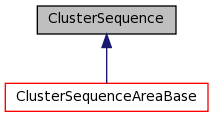
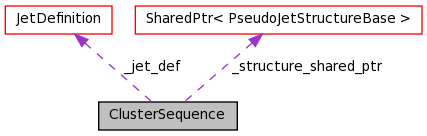
Classes | |
| class | Extras |
| base class to store extra information that plugins may provide More... | |
| struct | history_element |
| a single element in the clustering history More... | |
Public Types | |
| enum | JetType { Invalid = -3, InexistentParent = -2, BeamJet = -1 } |
| typedef ClusterSequenceStructure | StructureType |
| the structure type associated with a jet belonging to a ClusterSequence | |
Public Member Functions | |
| ClusterSequence () | |
| default constructor | |
| template<class L > | |
| ClusterSequence (const std::vector< L > &pseudojets, const double &R=1.0, const Strategy &strategy=Best, const bool &writeout_combinations=false) | |
| create a clustersequence starting from the supplied set of pseudojets and clustering them with the long-invariant kt algorithm (E-scheme recombination) with the supplied value for R. | |
| template<class L > | |
| ClusterSequence (const std::vector< L > &pseudojets, const JetDefinition &jet_def, const bool &writeout_combinations=false) | |
| create a clustersequence starting from the supplied set of pseudojets and clustering them with jet definition specified by jet_def (which also specifies the clustering strategy) | |
| std::vector< PseudoJet > | inclusive_jets (const double &ptmin=0.0) const |
| return a vector of all jets (in the sense of the inclusive algorithm) with pt >= ptmin. | |
| int | n_exclusive_jets (const double &dcut) const |
| return the number of jets (in the sense of the exclusive algorithm) that would be obtained when running the algorithm with the given dcut. | |
| std::vector< PseudoJet > | exclusive_jets (const double &dcut) const |
| return a vector of all jets (in the sense of the exclusive algorithm) that would be obtained when running the algorithm with the given dcut. | |
| std::vector< PseudoJet > | exclusive_jets (const int &njets) const |
| return a vector of all jets when the event is clustered (in the exclusive sense) to exactly njets. | |
| double | exclusive_dmerge (const int &njets) const |
| return the dmin corresponding to the recombination that went from n+1 to n jets (sometimes known as d_{n n+1}). | |
| double | exclusive_dmerge_max (const int &njets) const |
| return the maximum of the dmin encountered during all recombinations up to the one that led to an n-jet final state; identical to exclusive_dmerge, except in cases where the dmin do not increase monotonically. | |
| double | exclusive_ymerge (int njets) const |
| return the ymin corresponding to the recombination that went from n+1 to n jets (sometimes known as y_{n n+1}). | |
| double | exclusive_ymerge_max (int njets) const |
| same as exclusive_dmerge_max, but normalised to squared total energy | |
| int | n_exclusive_jets_ycut (double ycut) const |
| the number of exclusive jets at the given ycut | |
| std::vector< PseudoJet > | exclusive_jets_ycut (double ycut) const |
| the exclusive jets obtained at the given ycut | |
| std::vector< PseudoJet > | exclusive_subjets (const PseudoJet &jet, const double &dcut) const |
| return a vector of all subjets of the current jet (in the sense of the exclusive algorithm) that would be obtained when running the algorithm with the given dcut. | |
| int | n_exclusive_subjets (const PseudoJet &jet, const double &dcut) const |
| return the size of exclusive_subjets(...); still n ln n with same coefficient, but marginally more efficient than manually taking exclusive_subjets.size() | |
| std::vector< PseudoJet > | exclusive_subjets (const PseudoJet &jet, int nsub) const |
| return the list of subjets obtained by unclustering the supplied jet down to n subjets (or all constituents if there are fewer than n). | |
| double | exclusive_subdmerge (const PseudoJet &jet, int nsub) const |
| return the dij that was present in the merging nsub+1 -> nsub subjets inside this jet. | |
| double | exclusive_subdmerge_max (const PseudoJet &jet, int nsub) const |
| return the maximum dij that occurred in the whole event at the stage that the nsub+1 -> nsub merge of subjets occurred inside this jet. | |
| double | Q () const |
| returns the sum of all energies in the event (relevant mainly for e+e-) | |
| double | Q2 () const |
| return Q()^2 | |
| bool | object_in_jet (const PseudoJet &object, const PseudoJet &jet) const |
| returns true iff the object is included in the jet. | |
| bool | has_parents (const PseudoJet &jet, PseudoJet &parent1, PseudoJet &parent2) const |
| if the jet has parents in the clustering, it returns true and sets parent1 and parent2 equal to them. | |
| bool | has_child (const PseudoJet &jet, PseudoJet &child) const |
| if the jet has a child then return true and give the child jet otherwise return false and set the child to zero | |
| bool | has_child (const PseudoJet &jet, const PseudoJet *&childp) const |
| Version of has_child that sets a pointer to the child if the child exists;. | |
| bool | has_partner (const PseudoJet &jet, PseudoJet &partner) const |
| if this jet has a child (and so a partner) return true and give the partner, otherwise return false and set the partner to zero | |
| std::vector< PseudoJet > | constituents (const PseudoJet &jet) const |
| return a vector of the particles that make up jet | |
| void | print_jets_for_root (const std::vector< PseudoJet > &jets, std::ostream &ostr=std::cout) const |
| output the supplied vector of jets in a format that can be read by an appropriate root script; the format is: jet-n jet-px jet-py jet-pz jet-E particle-n particle-rap particle-phi particle-pt particle-n particle-rap particle-phi particle-pt ... | |
| void | print_jets_for_root (const std::vector< PseudoJet > &jets, const std::string &filename, const std::string &comment="") const |
| print jets for root to the file labelled filename, with an optional comment at the beginning | |
| void | add_constituents (const PseudoJet &jet, std::vector< PseudoJet > &subjet_vector) const |
| add on to subjet_vector the constituents of jet (for internal use mainly) | |
| Strategy | strategy_used () const |
| return the enum value of the strategy used to cluster the event | |
| std::string | strategy_string () const |
| return the name of the strategy used to cluster the event | |
| std::string | strategy_string (Strategy strategy_in) const |
| return the name of the strategy associated with the enum strategy_in | |
| const JetDefinition & | jet_def () const |
| return a reference to the jet definition | |
| double | jet_scale_for_algorithm (const PseudoJet &jet) const |
| returns the scale associated with a jet as required for this clustering algorithm (kt^2 for the kt-algorithm, 1 for the Cambridge algorithm). | |
| void | plugin_record_ij_recombination (int jet_i, int jet_j, double dij, int &newjet_k) |
| record the fact that there has been a recombination between jets()[jet_i] and jets()[jet_k], with the specified dij, and return the index (newjet_k) allocated to the new jet, whose momentum is assumed to be the 4-vector sum of that of jet_i and jet_j | |
| void | plugin_record_ij_recombination (int jet_i, int jet_j, double dij, const PseudoJet &newjet, int &newjet_k) |
| as for the simpler variant of plugin_record_ij_recombination, except that the new jet is attributed the momentum and user_index of newjet | |
| void | plugin_record_iB_recombination (int jet_i, double diB) |
| record the fact that there has been a recombination between jets()[jet_i] and the beam, with the specified diB; when looking for inclusive jets, any iB recombination will returned to the user as a jet. | |
| void | plugin_associate_extras (std::auto_ptr< Extras > extras_in) |
| the plugin can associated some extra information with the ClusterSequence object by calling this function | |
| bool | plugin_activated () const |
| returns true when the plugin is allowed to run the show. | |
| const Extras * | extras () const |
| returns a pointer to the extras object (may be null) | |
| template<class GBJ > | |
| void | plugin_simple_N2_cluster () |
| allows a plugin to run a templated clustering (nearest-neighbour heuristic) | |
| const std::vector< PseudoJet > & | jets () const |
| allow the user to access the internally stored _jets() array, which contains both the initial particles and the various intermediate and final stages of recombination. | |
| const std::vector < history_element > & | history () const |
| allow the user to access the raw internal history. | |
| unsigned int | n_particles () const |
| returns the number of particles that were provided to the clustering algorithm (helps the user find their way around the history and jets objects if they weren't paying attention beforehand). | |
| std::vector< int > | particle_jet_indices (const std::vector< PseudoJet > &) const |
| returns a vector of size n_particles() which indicates, for each of the initial particles (in the order in which they were supplied), which of the supplied jets it belongs to; if it does not belong to any of the supplied jets, the index is set to -1; | |
| std::vector< int > | unique_history_order () const |
| routine that returns an order in which to read the history such that clusterings that lead to identical jet compositions but different histories (because of degeneracies in the clustering order) will have matching constituents for each matching entry in the unique_history_order. | |
| std::vector< PseudoJet > | unclustered_particles () const |
| return the set of particles that have not been clustered. | |
| bool | contains (const PseudoJet &object) const |
| returns true if the object (jet or particle) is contained by (ie belongs to) this cluster sequence. | |
| void | transfer_from_sequence (ClusterSequence &from_seq, bool transfer_ownership=true) |
| transfer the sequence contained in other_seq into our own; any plugin "extras" contained in the from_seq will be lost from there. | |
| const SharedPtr < PseudoJetStructureBase > & | structure_shared_ptr () const |
| retrieve a shared pointer to the wrapper to this ClusterSequence | |
| template<> | |
| void | _bj_set_jetinfo (EEBriefJet *const jetA, const int _jets_index) const |
| template<> | |
| double | _bj_dist (const EEBriefJet *const jeta, const EEBriefJet *const jetb) const |
Static Public Member Functions | |
| static void | set_jet_algorithm (JetAlgorithm jet_algorithm) |
| set the default (static) jet finder across all current and future ClusterSequence objects -- deprecated and obsolescent (i.e. | |
| static void | set_jet_finder (JetAlgorithm jet_algorithm) |
| same as above for backward compatibility | |
Protected Member Functions | |
| template<class L > | |
| void | _transfer_input_jets (const std::vector< L > &pseudojets) |
| transfer the vector<L> of input jets into our own vector<PseudoJet> _jets (with some reserved space for future growth). | |
| void | _initialise_and_run (const JetDefinition &jet_def, const bool &writeout_combinations) |
| This is the routine that will do all the initialisation and then run the clustering (may be called by various constructors). | |
| void | _initialise_and_run (const double &R, const Strategy &strategy, const bool &writeout_combinations) |
| This is an alternative routine for initialising and running the clustering, provided for legacy purposes. | |
| void | _decant_options (const JetDefinition &jet_def, const bool &writeout_combinations) |
| fills in the various member variables with "decanted" options from the jet_definition and writeout_combinations variables | |
| void | _fill_initial_history () |
| fill out the history (and jet cross refs) related to the initial set of jets (assumed already to have been "transferred"), without any clustering | |
| void | _do_ij_recombination_step (const int &jet_i, const int &jet_j, const double &dij, int &newjet_k) |
| carry out the recombination between the jets numbered jet_i and jet_j, at distance scale dij; return the index newjet_k of the result of the recombination of i and j. | |
| void | _do_iB_recombination_step (const int &jet_i, const double &diB) |
| carry out an recombination step in which _jets[jet_i] merges with the beam, | |
| void | get_subhist_set (std::set< const history_element * > &subhist, const PseudoJet &jet, double dcut, int maxjet) const |
set subhist to be a set pointers to history entries corresponding to the subjets of this jet; one stops going working down through the subjets either when
| |
Protected Attributes | |
| JetDefinition | _jet_def |
| std::vector< PseudoJet > | _jets |
| This contains the physical PseudoJets; for each PseudoJet one can find the corresponding position in the _history by looking at _jets[i].cluster_hist_index(). | |
| std::vector< history_element > | _history |
| this vector will contain the branching history; for each stage, _history[i].jetp_index indicates where to look in the _jets vector to get the physical PseudoJet. | |
| bool | _writeout_combinations |
| int | _initial_n |
| double | _Rparam |
| double | _R2 |
| double | _invR2 |
| double | _Qtot |
| Strategy | _strategy |
| JetAlgorithm | _jet_algorithm |
| SharedPtr< PseudoJetStructureBase > | _structure_shared_ptr |
Static Protected Attributes | |
| static JetAlgorithm | _default_jet_algorithm = kt_algorithm |
Detailed Description
deals with clustering
Definition at line 111 of file ClusterSequence.hh.
Constructor & Destructor Documentation
| ClusterSequence::ClusterSequence | ( | const std::vector< L > & | pseudojets, |
| const double & | R = 1.0, |
||
| const Strategy & | strategy = Best, |
||
| const bool & | writeout_combinations = false |
||
| ) |
create a clustersequence starting from the supplied set of pseudojets and clustering them with the long-invariant kt algorithm (E-scheme recombination) with the supplied value for R.
If strategy=DumbN3 a very stupid N^3 algorithm is used for the clustering; otherwise strategy = NlnN* uses cylinders algorithms with some number of pi coverage. If writeout_combinations=true a summary of the recombination sequence is written out
Definition at line 860 of file ClusterSequence.hh.
References _initialise_and_run(), and _transfer_input_jets().
                                                                      {

  // transfer the initial jets (type L) into our own array
  _transfer_input_jets(pseudojets);

  // run the clustering
  _initialise_and_run(R,strategy,writeout_combinations);
}
| ClusterSequence::ClusterSequence | ( | const std::vector< L > & | pseudojets, |
| const JetDefinition & | jet_def, | ||
| const bool & | writeout_combinations = false |
||
| ) |
create a clustersequence starting from the supplied set of pseudojets and clustering them with jet definition specified by jet_def (which also specifies the clustering strategy)
constructor of a jet-clustering sequence from a vector of four-momenta, with the jet definition specified by jet_def
Definition at line 877 of file ClusterSequence.hh.
References _initialise_and_run(), and _transfer_input_jets().
                                                                      {

  // transfer the initial jets (type L) into our own array
  _transfer_input_jets(pseudojets);

  // run the clustering
  _initialise_and_run(jet_def,writeout_combinations);
}
Member Function Documentation
| vector< PseudoJet > ClusterSequence::inclusive_jets | ( | const double & | ptmin = 0.0 | ) | const |
return a vector of all jets (in the sense of the inclusive algorithm) with pt >= ptmin.
Time taken should be of the order of the number of jets returned.
Definition at line 435 of file ClusterSequence.cc.
Referenced by Filter::_set_filtered_elements_generic_unsubtracted(), BackgroundEstimator::BackgroundEstimator(), and main().
                                                                            {
  double dcut = ptmin*ptmin;
  int i = _history.size() - 1; // last jet
  vector<PseudoJet> jets;
  if (_jet_algorithm == kt_algorithm) {
    while (i >= 0) {
      // with our specific definition of dij and diB (i.e. R appears only in
      // dij), then dij==diB is the same as the jet.perp2() and we can exploit
      // this in selecting the jets...
      if (_history[i].max_dij_so_far < dcut) {break;}
      if (_history[i].parent2 == BeamJet && _history[i].dij >= dcut) {
        // for beam jets
        int parent1 = _history[i].parent1;
        jets.push_back(_jets[_history[parent1].jetp_index]);}
      i--;
    }
  } else if (_jet_algorithm == cambridge_algorithm) {
    while (i >= 0) {
      // inclusive jets are all at end of clustering sequence in the
      // Cambridge algorithm -- so if we find a non-exclusive jet, then
      // we can exit
      if (_history[i].parent2 != BeamJet) {break;}
      int parent1 = _history[i].parent1;
      const PseudoJet & jet = _jets[_history[parent1].jetp_index];
      if (jet.perp2() >= dcut) {jets.push_back(jet);}
      i--;
    }
  } else if (_jet_algorithm == plugin_algorithm
             || _jet_algorithm == ee_kt_algorithm
             || _jet_algorithm == antikt_algorithm
             || _jet_algorithm == genkt_algorithm
             || _jet_algorithm == ee_genkt_algorithm
             || _jet_algorithm == cambridge_for_passive_algorithm) {
    // for inclusive jets with a plugin algorithm, we make no
    // assumptions about anything (relation of dij to momenta,
    // ordering of the dij, etc.)
    while (i >= 0) {
      if (_history[i].parent2 == BeamJet) {
        int parent1 = _history[i].parent1;
        const PseudoJet & jet = _jets[_history[parent1].jetp_index];
        if (jet.perp2() >= dcut) {jets.push_back(jet);}
      }
      i--;
    }
  } else {throw Error("cs::inclusive_jets(...): Unrecognized jet algorithm");}
  return jets;
}
| int ClusterSequence::n_exclusive_jets | ( | const double & | dcut | ) | const |
return the number of jets (in the sense of the exclusive algorithm) that would be obtained when running the algorithm with the given dcut.
Definition at line 487 of file ClusterSequence.cc.
Referenced by n_exclusive_jets_ycut().
                                                                {

  // first locate the point where clustering would have stopped (i.e. the
  // first time max_dij_so_far > dcut)
  int i = _history.size() - 1; // last jet
  while (i >= 0) {
    if (_history[i].max_dij_so_far <= dcut) {break;}
    i--;
  }
  int stop_point = i + 1;
  // relation between stop_point, njets assumes one extra jet disappears
  // at each clustering.
  int njets = 2*_initial_n - stop_point;
  return njets;
}
| vector< PseudoJet > ClusterSequence::exclusive_jets | ( | const double & | dcut | ) | const |
return a vector of all jets (in the sense of the exclusive algorithm) that would be obtained when running the algorithm with the given dcut.
Definition at line 506 of file ClusterSequence.cc.
Referenced by exclusive_jets_ycut().
                                                                            {
  int njets = n_exclusive_jets(dcut);
  return exclusive_jets(njets);
}
| vector< PseudoJet > ClusterSequence::exclusive_jets | ( | const int & | njets | ) | const |
return a vector of all jets when the event is clustered (in the exclusive sense) to exactly njets.
If there are fewer than njets particles in the ClusterSequence then FastJet crashes since it is not able to return njets exclusive jets.
Definition at line 514 of file ClusterSequence.cc.
                                                                          {

  // make sure the user does not ask for more than jets than there
  // were particles in the first place.
  assert (njets <= _initial_n);

  // provide a warning when extracting exclusive jets for algorithms
  // that does not support it explicitly.
  // Native algorithm that support it are: kt, ee_kt, cambridge,
  //   genkt and ee_genkt (both with p>=0)
  // For plugins, we check Plugin::exclusive_sequence_meaningful()
  if (( _jet_def.jet_algorithm() != kt_algorithm) &&
      ( _jet_def.jet_algorithm() != cambridge_algorithm) &&
      ( _jet_def.jet_algorithm() != ee_kt_algorithm) &&
      (((_jet_def.jet_algorithm() != genkt_algorithm) &&
        (_jet_def.jet_algorithm() != ee_genkt_algorithm)) ||
       (_jet_def.extra_param() <0)) &&
      ((_jet_def.jet_algorithm() != plugin_algorithm) ||
       (!_jet_def.plugin()->exclusive_sequence_meaningful())) &&
      (_n_exclusive_warnings < 5)) {
    _n_exclusive_warnings++;
    cerr << "FastJet WARNING: dcut and exclusive jets for jet-finders other than kt should be interpreted with care." << endl;
  }


  // calculate the point where we have to stop the clustering.
  // relation between stop_point, njets assumes one extra jet disappears
  // at each clustering.
  int stop_point = 2*_initial_n - njets;

  // some sanity checking to make sure that e+e- does not give us
  // surprises (should we ever implement e+e-)...
  if (2*_initial_n != static_cast<int>(_history.size())) {
    ostringstream err;
    err << "2*_initial_n != _history.size() -- this endangers internal assumptions!\n";
    throw Error(err.str());
    //assert(false);
  }

  // now go forwards and reconstitute the jets that we have --
  // basically for any history element, see if the parent jets to
  // which it refers were created before the stopping point -- if they
  // were then add them to the list, otherwise they are subsequent
  // recombinations of the jets that we are looking for.
  vector<PseudoJet> jets;
  for (unsigned int i = stop_point; i < _history.size(); i++) {
    int parent1 = _history[i].parent1;
    if (parent1 < stop_point) {
      jets.push_back(_jets[_history[parent1].jetp_index]);
    }
    int parent2 = _history[i].parent2;
    if (parent2 < stop_point && parent2 > 0) {
      jets.push_back(_jets[_history[parent2].jetp_index]);
    }

  }

  // sanity check...
  if (static_cast<int>(jets.size()) != njets) {
    ostringstream err;
    err << "ClusterSequence::exclusive_jets: size of returned vector ("
         <<jets.size()<<") does not coincide with requested number of jets ("
         <<njets<<")";
    throw Error(err.str());
  }

  return jets;
}
| double ClusterSequence::exclusive_dmerge | ( | const int & | njets | ) | const |
return the dmin corresponding to the recombination that went from n+1 to n jets (sometimes known as d_{n n+1}).
return the dmin corresponding to the recombination that went from n+1 to n jets
Definition at line 586 of file ClusterSequence.cc.
Referenced by exclusive_ymerge().
                                                                 {
  assert(njets >= 0);
  if (njets >= _initial_n) {return 0.0;}
  return _history[2*_initial_n-njets-1].dij;
}
| double ClusterSequence::exclusive_dmerge_max | ( | const int & | njets | ) | const |
return the maximum of the dmin encountered during all recombinations up to the one that led to an n-jet final state; identical to exclusive_dmerge, except in cases where the dmin do not increase monotonically.
Definition at line 598 of file ClusterSequence.cc.
Referenced by exclusive_ymerge_max().
                                                                     {
  assert(njets >= 0);
  if (njets >= _initial_n) {return 0.0;}
  return _history[2*_initial_n-njets-1].max_dij_so_far;
}
| double ClusterSequence::exclusive_ymerge | ( | int | njets | ) | const [inline] |
return the ymin corresponding to the recombination that went from n+1 to n jets (sometimes known as y_{n n+1}).
Definition at line 185 of file ClusterSequence.hh.
References exclusive_dmerge(), and Q2().
{return exclusive_dmerge(njets) / Q2();}
| std::vector< PseudoJet > ClusterSequence::exclusive_subjets | ( | const PseudoJet & | jet, |
| const double & | dcut | ||
| ) | const |
return a vector of all subjets of the current jet (in the sense of the exclusive algorithm) that would be obtained when running the algorithm with the given dcut.
Time taken is O(m ln m), where m is the number of subjets that are found. If m gets to be of order of the total number of constituents in the jet, this could be substantially slower than just getting that list of constituents.
Definition at line 610 of file ClusterSequence.cc.
                                                      {

  set<const history_element*> subhist;

  // get the set of history elements that correspond to subjets at
  // scale dcut
  get_subhist_set(subhist, jet, dcut, 0);

  // now transfer this into a sequence of jets
  vector<PseudoJet> subjets;
  subjets.reserve(subhist.size());
  for (set<const history_element*>::iterator elem = subhist.begin();
       elem != subhist.end(); elem++) {
    subjets.push_back(_jets[(*elem)->jetp_index]);
  }
  return subjets;
}
| std::vector< PseudoJet > ClusterSequence::exclusive_subjets | ( | const PseudoJet & | jet, |
| int | n | ||
| ) | const |
return the list of subjets obtained by unclustering the supplied jet down to n subjets (or all constituents if there are fewer than n).
This requires n ln n time
If the jet contains fewer than nsub particles (in which case it is not possible to return nsub subjets) then the vector of subjets that is returned is simply the list of particles (of size < nsub). Note that this behaviour differs from that of exclusive_jets().
Definition at line 646 of file ClusterSequence.cc.
                                        {

  set<const history_element*> subhist;

  // get the set of history elements that correspond to subjets at
  // scale dcut
  get_subhist_set(subhist, jet, -1.0, n);

  // now transfer this into a sequence of jets
  vector<PseudoJet> subjets;
  subjets.reserve(subhist.size());
  for (set<const history_element*>::iterator elem = subhist.begin();
       elem != subhist.end(); elem++) {
    subjets.push_back(_jets[(*elem)->jetp_index]);
  }
  return subjets;
}
| double ClusterSequence::exclusive_subdmerge | ( | const PseudoJet & | jet, |
| int | nsub | ||
| ) | const |
return the dij that was present in the merging nsub+1 -> nsub subjets inside this jet.
Returns 0 if there were nsub or fewer constituents in the jet.
If the jet has nsub or fewer constituents, it will return 0.
will be zero if nconst <= nsub, since highest will be an original particle have zero dij
Definition at line 670 of file ClusterSequence.cc.
                                                                                 {
  set<const history_element*> subhist;

  // get the set of history elements that correspond to subjets at
  // scale dcut
  get_subhist_set(subhist, jet, -1.0, nsub);

  set<const history_element*>::iterator highest = subhist.end();
  highest--;
  /// will be zero if nconst <= nsub, since highest will be an original
  /// particle have zero dij
  return (*highest)->dij;
}
| double ClusterSequence::exclusive_subdmerge_max | ( | const PseudoJet & | jet, |
| int | nsub | ||
| ) | const |
return the maximum dij that occurred in the whole event at the stage that the nsub+1 -> nsub merge of subjets occurred inside this jet.
Returns 0 if there were nsub or fewer constituents in the jet.
If the jet has nsub or fewer constituents, it will return 0.
will be zero if nconst <= nsub, since highest will be an original particle have zero dij
Definition at line 691 of file ClusterSequence.cc.
                                                                                     {

  set<const history_element*> subhist;

  // get the set of history elements that correspond to subjets at
  // scale dcut
  get_subhist_set(subhist, jet, -1.0, nsub);

  set<const history_element*>::iterator highest = subhist.end();
  highest--;
  /// will be zero if nconst <= nsub, since highest will be an original
  /// particle have zero dij
  return (*highest)->max_dij_so_far;
}
| bool ClusterSequence::object_in_jet | ( | const PseudoJet & | object, |
| const PseudoJet & | jet | ||
| ) | const |
returns true iff the object is included in the jet.
NB: this is only sensible if the object is already registered within the cluster sequence, so you cannot use it with an input particle to the CS (since the particle won't have the history index set properly).
For nice clustering structures it should run in O(ln(N)) time but in worst cases (certain cone plugins) it can take O(n) time, where n is the number of particles in the jet.
Definition at line 749 of file ClusterSequence.cc.
                                                                 {

  // make sure the object conceivably belongs to this clustering
  // sequence
  assert(contains(object) && contains(jet));

  const PseudoJet * this_object = &object;
  const PseudoJet * childp;
  while(true) {
    if (this_object->cluster_hist_index() == jet.cluster_hist_index()) {
      return true;
    } else if (has_child(*this_object, childp)) {
      this_object = childp;
    } else {
      return false;
    }
  }
}
| bool ClusterSequence::has_parents | ( | const PseudoJet & | jet, |
| PseudoJet & | parent1, | ||
| PseudoJet & | parent2 | ||
| ) | const |
if the jet has parents in the clustering, it returns true and sets parent1 and parent2 equal to them.
if it has no parents it returns false and sets parent1 and parent2 to zero
Definition at line 775 of file ClusterSequence.cc.
References ClusterSequence::history_element::parent2.
                                                         {

  const history_element & hist = _history[jet.cluster_hist_index()];

  // make sure we do not run into any unexpected situations --
  // i.e. both parents valid, or neither
  assert ((hist.parent1 >= 0 && hist.parent2 >= 0) ||
          (hist.parent1 < 0 && hist.parent2 < 0));

  if (hist.parent1 < 0) {
    parent1 = PseudoJet(0.0,0.0,0.0,0.0);
    parent2 = parent1;
    return false;
  } else {
    parent1 = _jets[_history[hist.parent1].jetp_index];
    parent2 = _jets[_history[hist.parent2].jetp_index];
    // order the parents in decreasing pt
    if (parent1.perp2() < parent2.perp2()) std::swap(parent1,parent2);
    return true;
  }
}
| void ClusterSequence::print_jets_for_root | ( | const std::vector< PseudoJet > & | jets, |
| std::ostream & | ostr = std::cout |
||
| ) | const |
output the supplied vector of jets in a format that can be read by an appropriate root script; the format is: jet-n jet-px jet-py jet-pz jet-E particle-n particle-rap particle-phi particle-pt particle-n particle-rap particle-phi particle-pt ...
#END ... [i.e. above repeated]
| double ClusterSequence::jet_scale_for_algorithm | ( | const PseudoJet & | jet | ) | const |
returns the scale associated with a jet as required for this clustering algorithm (kt^2 for the kt-algorithm, 1 for the Cambridge algorithm).
[May become virtual at some point]
Definition at line 361 of file ClusterSequence.cc.
                                                               {
  if (_jet_algorithm == kt_algorithm)             {return jet.kt2();}
  else if (_jet_algorithm == cambridge_algorithm) {return 1.0;}
  else if (_jet_algorithm == antikt_algorithm) {
    double kt2=jet.kt2();
    return kt2 > 1e-300 ? 1.0/kt2 : 1e300;
  } else if (_jet_algorithm == genkt_algorithm) {
    double kt2 = jet.kt2();
    double p   = jet_def().extra_param();
    if (p <= 0 && kt2 < 1e-300) kt2 = 1e-300; // dodgy safety check
    return pow(kt2, p);
  } else if (_jet_algorithm == cambridge_for_passive_algorithm) {
    double kt2 = jet.kt2();
    double lim = _jet_def.extra_param();
    if (kt2 < lim*lim && kt2 != 0.0) {
      return 1.0/kt2;
    } else {return 1.0;}
  } else {throw Error("Unrecognised jet algorithm");}
}
| void ClusterSequence::plugin_record_iB_recombination | ( | int | jet_i, |
| double | diB | ||
| ) | [inline] |
record the fact that there has been a recombination between jets()[jet_i] and the beam, with the specified diB; when looking for inclusive jets, any iB recombination will returned to the user as a jet.
Definition at line 361 of file ClusterSequence.hh.
References _do_iB_recombination_step(), and plugin_activated().
Referenced by TrackJetPlugin::run_clustering(), SISConeSphericalPlugin::run_clustering(), SISConePlugin::run_clustering(), PxConePlugin::run_clustering(), NestedDefsPlugin::run_clustering(), JadePlugin::run_clustering(), EECambridgePlugin::run_clustering(), D0RunIIConePlugin::run_clustering(), CMSIterativeConePlugin::run_clustering(), CDFMidPointPlugin::run_clustering(), CDFJetCluPlugin::run_clustering(), and ATLASConePlugin::run_clustering().
                                                             {
    assert(plugin_activated());
    _do_iB_recombination_step(jet_i, diB);
  }
| void ClusterSequence::plugin_simple_N2_cluster | ( | ) | [inline] |
allows a plugin to run a templated clustering (nearest-neighbour heuristic)
This has N^2 behaviour on "good" distance, but a worst case behaviour of N^3 (and many algs trigger the worst case behaviour)
For more details on how this works, see GenBriefJet below
Definition at line 398 of file ClusterSequence.hh.
References plugin_activated().
                                                       {
    assert(plugin_activated());
    _simple_N2_cluster<GBJ>();
  }
| static void ClusterSequence::set_jet_algorithm | ( | JetAlgorithm | jet_algorithm | ) | [inline, static] |
set the default (static) jet finder across all current and future ClusterSequence objects -- deprecated and obsolescent (i.e.
may be suppressed in a future release).
Definition at line 408 of file ClusterSequence.hh.
{_default_jet_algorithm = jet_algorithm;}
| const std::vector< PseudoJet > & ClusterSequence::jets | ( | ) | const [inline] |
allow the user to access the internally stored _jets() array, which contains both the initial particles and the various intermediate and final stages of recombination.
The first n_particles() entries are the original particles, in the order in which they were supplied to the ClusterSequence constructor. It can be useful to access them for example when examining whether a given input object is part of a specific jet, via the objects_in_jet(...) member function (which only takes PseudoJets that are registered in the ClusterSequence).
One of the other (internal uses) is related to the fact because we don't seem to be able to access protected elements of the class for an object that is not "this" (at least in case where "this" is of a slightly different kind from the object, both derived from ClusterSequence).
Definition at line 890 of file ClusterSequence.hh.
References _jets.
Referenced by ClusterSequenceActiveArea::_transfer_areas(), TrackJetPlugin::run_clustering(), SISConeSphericalPlugin::run_clustering(), SISConePlugin::run_clustering(), PxConePlugin::run_clustering(), NestedDefsPlugin::run_clustering(), JadePlugin::run_clustering(), EECambridgePlugin::run_clustering(), D0RunIIConePlugin::run_clustering(), CMSIterativeConePlugin::run_clustering(), CDFMidPointPlugin::run_clustering(), CDFJetCluPlugin::run_clustering(), and ATLASConePlugin::run_clustering().
                                                                 {
  return _jets;
}
| const std::vector< ClusterSequence::history_element > & ClusterSequence::history | ( | ) | const [inline] |
allow the user to access the raw internal history.
This is present (as for jets()) in part so that protected derived classes can access this information about other ClusterSequences.
A user who wishes to follow the details of the ClusterSequence can also make use of this information (and should consult the history_element documentation for more information), but should be aware that these internal structures may evolve in future FastJet versions.
Definition at line 894 of file ClusterSequence.hh.
References _history.
Referenced by ClusterSequenceActiveArea::_transfer_areas(), ClusterSequenceActiveArea::_transfer_ghost_free_history(), and NestedDefsPlugin::run_clustering().
                                                                                         {
  return _history;
}
| unsigned int ClusterSequence::n_particles | ( | ) | const [inline] |
returns the number of particles that were provided to the clustering algorithm (helps the user find their way around the history and jets objects if they weren't paying attention beforehand).
Definition at line 898 of file ClusterSequence.hh.
Referenced by ClusterSequenceActiveArea::_transfer_areas().
{return _initial_n;}
| vector< int > ClusterSequence::unique_history_order | ( | ) | const |
routine that returns an order in which to read the history such that clusterings that lead to identical jet compositions but different histories (because of degeneracies in the clustering order) will have matching constituents for each matching entry in the unique_history_order.
The order has the property that an entry's parents will always appear prior to that entry itself.
Roughly speaking the order is such that we first provide all steps that lead to the final jet containing particle 1; then we have the steps that lead to reconstruction of the jet containing the next-lowest-numbered unclustered particle, etc... [see GPS CCN28-12 for more info -- of course a full explanation here would be better...]
Definition at line 1037 of file ClusterSequence.cc.
Referenced by ClusterSequenceActiveArea::_transfer_areas().
                                                        {

  // first construct an array that will tell us the lowest constituent
  // of a given jet -- this will always be one of the original
  // particles, whose order is well defined and so will help us to
  // follow the tree in a unique manner.
  valarray<int> lowest_constituent(_history.size());
  int hist_n = _history.size();
  lowest_constituent = hist_n; // give it a large number
  for (int i = 0; i < hist_n; i++) {
    // sets things up for the initial partons
    lowest_constituent[i] = min(lowest_constituent[i],i);
    // propagates them through to the children of this parton
    if (_history[i].child > 0) lowest_constituent[_history[i].child]
      = min(lowest_constituent[_history[i].child],lowest_constituent[i]);
  }

  // establish an array for what we have and have not extracted so far
  valarray<bool> extracted(_history.size()); extracted = false;
  vector<int> unique_tree;
  unique_tree.reserve(_history.size());

  // now work our way through the tree
  for (unsigned i = 0; i < n_particles(); i++) {
    if (!extracted[i]) {
      unique_tree.push_back(i);
      extracted[i] = true;
      _extract_tree_children(i, extracted, lowest_constituent, unique_tree);
    }
  }

  return unique_tree;
}
| vector< PseudoJet > ClusterSequence::unclustered_particles | ( | ) | const |
return the set of particles that have not been clustered.
For kt and cam/aachen algorithms this should always be null, but for cone type algorithms it can be non-null;
Definition at line 1092 of file ClusterSequence.cc.
Referenced by ClusterSequenceActiveArea::_transfer_areas().
                                                               {
  vector<PseudoJet> unclustered;
  for (unsigned i = 0; i < n_particles() ; i++) {
    if (_history[i].child == Invalid)
      unclustered.push_back(_jets[_history[i].jetp_index]);
  }
  return unclustered;
}
| bool ClusterSequence::contains | ( | const PseudoJet & | object | ) | const |
returns true if the object (jet or particle) is contained by (ie belongs to) this cluster sequence.
Tests performed: if thejet's interface is this cluster sequence and its cluster history index is in a consistent range.
Definition at line 1107 of file ClusterSequence.cc.
                                                          {
  return jet.cluster_hist_index() >= 0
    &&   jet.cluster_hist_index() < int(_history.size())
    &&   jet.structure_shared_ptr() == structure_shared_ptr();
}
| void ClusterSequence::transfer_from_sequence | ( | ClusterSequence & | from_seq, |
| bool | transfer_ownership = true |
||
| ) |
transfer the sequence contained in other_seq into our own; any plugin "extras" contained in the from_seq will be lost from there.
If transfer_ownership is true, it also sets the ClusterSequence pointers of the PseudoJets in the history to point to this ClusterSequence (true by default)
Definition at line 387 of file ClusterSequence.cc.
References _history, and _jets.
                                                                                                {

  // the metadata
  _jet_def                 = from_seq._jet_def                ;
  _writeout_combinations   = from_seq._writeout_combinations  ;
  _initial_n               = from_seq._initial_n              ;
  _Rparam                  = from_seq._Rparam                 ;
  _R2                      = from_seq._R2                     ;
  _invR2                   = from_seq._invR2                  ;
  _strategy                = from_seq._strategy               ;
  _jet_algorithm           = from_seq._jet_algorithm          ;
  _plugin_activated        = from_seq._plugin_activated       ;

  // the data
  _jets     = from_seq._jets;
  _history  = from_seq._history;
  // the following transferse ownership of the extras from the from_seq
  _extras   = from_seq._extras;

  // transfer of ownership
  if (transfer_ownership){
    // make sure we have an initialised wrapper. If not, initialise it
    if (! _structure_shared_ptr()) _structure_shared_ptr.reset(new ClusterSequenceStructure(this));

    for (vector<PseudoJet>::iterator jit = _jets.begin(); jit != _jets.end(); jit++)
      jit->set_structure_shared_ptr(_structure_shared_ptr);
  }
}
| const SharedPtr<PseudoJetStructureBase>& ClusterSequence::structure_shared_ptr | ( | ) | const [inline] |
retrieve a shared pointer to the wrapper to this ClusterSequence
this may turn useful if you want to track when this ClusterSequence goes out of scope
Definition at line 535 of file ClusterSequence.hh.
Referenced by BackgroundEstimator::BackgroundEstimator().
                                                                        {
    return _structure_shared_ptr;
  }
| void ClusterSequence::_transfer_input_jets | ( | const std::vector< L > & | pseudojets | ) | [protected] |
transfer the vector<L> of input jets into our own vector<PseudoJet> _jets (with some reserved space for future growth).
Definition at line 841 of file ClusterSequence.hh.
References _jets.
Referenced by ClusterSequence().
                                                                        {

  // this will ensure that we can point to jets without difficulties
  // arising.
  _jets.reserve(pseudojets.size()*2);

  // insert initial jets this way so that any type L that can be
  // converted to a pseudojet will work fine (basically PseudoJet
  // and any type that has [] subscript access to the momentum
  // components, such as CLHEP HepLorentzVector).
  for (unsigned int i = 0; i < pseudojets.size(); i++) {
    _jets.push_back(pseudojets[i]);}

}
| void ClusterSequence::_initialise_and_run | ( | const JetDefinition & | jet_def, |
| const bool & | writeout_combinations | ||
| ) | [protected] |
This is the routine that will do all the initialisation and then run the clustering (may be called by various constructors).
It assumes _jets contains the momenta to be clustered.
Definition at line 81 of file ClusterSequence.cc.
Referenced by ClusterSequence().
                                                                      {

  // transfer all relevant info into internal variables
  _decant_options(jet_def, writeout_combinations);

  // set up the history entries for the initial particles (those
  // currently in _jets)
  _fill_initial_history();

  // don't run anything if the event is empty
  if (n_particles() == 0) return;

  // ----- deal with special cases: plugins & e+e- ------
  if (_jet_algorithm == plugin_algorithm) {
    // allows plugin_xyz() functions to modify cluster sequence
    _plugin_activated = true;
    // let the plugin do its work here
    _jet_def.plugin()->run_clustering( (*this) );
    _plugin_activated = false;
    return;
  } else if (_jet_algorithm == ee_kt_algorithm ||
             _jet_algorithm == ee_genkt_algorithm) {
    // ignore requested strategy
    _strategy = N2Plain;
    if (_jet_algorithm == ee_kt_algorithm) {
      // make sure that R is large enough so that "beam" recomb only
      // occurs when a single particle is left
      // Normally, this should be automatically set to 4 from JetDefinition
      assert(_Rparam > 2.0);
      // this is used to renormalise the dij to get a "standard" form
      // and our convention in e+e- will be different from that
      // in long.inv case; NB: _invR2 name should be changed -> _renorm_dij?
      _invR2 = 1.0;
    } else {
      // as of 2009-01-09, choose R to be an angular distance, in
      // radians.  Since the algorithm uses 2(1-cos(theta)) as its
      // squared angular measure, make sure that the _R2 is defined
      // in a similar way.
      if (_Rparam > pi) {
        // choose a value that ensures that back-to-back particles will
        // always recombine
        //_R2 = 4.0000000000001;
        _R2 = 2 * ( 3.0 + cos(_Rparam) );
      } else {
        _R2    = 2 * ( 1.0 - cos(_Rparam) );
      }
      _invR2 = 1.0/_R2;
    }
    //_simple_N2_cluster<EEBriefJet>();
    _simple_N2_cluster_EEBriefJet();
    return;
  }


  // automatically redefine the strategy according to N if that is
  // what the user requested -- transition points (and especially
  // their R-dependence) are based on empirical observations for a
  // R=0.4, 0.7 and 1.0, running on toth (3.4GHz, Pentium IV D [dual
  // core] with 2MB of cache).
  if (_strategy == Best) {
    int N = _jets.size();
    if (N <= 55*max(0.5,min(1.0,_Rparam))) {// empirical scaling with R
      _strategy = N2Plain;
    } else if (N > 6200/pow(_Rparam,2.0) && jet_def.jet_algorithm() == cambridge_algorithm) {
      _strategy = NlnNCam;
#ifndef DROP_CGAL
    } else if ((N > 16000/pow(_Rparam,1.15) && jet_def.jet_algorithm() != antikt_algorithm)
               || N > 35000/pow(_Rparam,1.15)) {
      _strategy = NlnN;
#endif  // DROP_CGAL
    } else if (N <= 450) {
      _strategy = N2Tiled;
    } else {
      _strategy = N2MinHeapTiled;
    }
  }

  // R >= 2pi is not supported by all clustering strategies owing to
  // periodicity issues (a particle might cluster with itself). When
  // R>=2pi, we therefore automatically switch to a strategy that is
  // known to work.
  if (_Rparam >= twopi) {
    if (   _strategy == NlnN
        || _strategy == NlnN3pi
        || _strategy == NlnNCam
        || _strategy == NlnNCam2pi2R
        || _strategy == NlnNCam4pi) {
#ifdef DROP_CGAL
      _strategy = N2MinHeapTiled;
#else
      _strategy = NlnN4pi;
#endif
    }
    if (jet_def.strategy() != Best && _strategy != jet_def.strategy()) {
      ostringstream oss;
      oss << "Cluster strategy " << strategy_string(jet_def.strategy())
          << " automatically changed to " << strategy_string()
          << " because the former is not supported for R = " << _Rparam
          << " >= 2pi";
      _changed_strategy_warning.warn(oss.str());
    }
  }


  // run the code containing the selected strategy
  //
  // We order the strategies stqrting from the ones used by the Best
  // strategy in the order of increasing N, then the remaining ones
  // again in the order of increasing N.
  if (_strategy == N2Plain) {
    // BriefJet provides standard long.invariant kt alg.
    this->_simple_N2_cluster_BriefJet();
  } else if (_strategy == N2Tiled) {
    this->_faster_tiled_N2_cluster();
  } else if (_strategy == N2MinHeapTiled) {
    this->_minheap_faster_tiled_N2_cluster();
  } else if (_strategy == NlnN) {
    this->_delaunay_cluster();
  } else if (_strategy == NlnNCam) {
    this->_CP2DChan_cluster_2piMultD();
  } else if (_strategy == NlnN3pi || _strategy == NlnN4pi ) {
    this->_delaunay_cluster();
  } else if (_strategy ==  N3Dumb ) {
    this->_really_dumb_cluster();
  } else if (_strategy == N2PoorTiled) {
    this->_tiled_N2_cluster();
  } else if (_strategy == NlnNCam4pi) {
    this->_CP2DChan_cluster();
  } else if (_strategy == NlnNCam2pi2R) {
    this->_CP2DChan_cluster_2pi2R();
  } else {
    ostringstream err;
    err << "Unrecognised value for strategy: "<<_strategy;
    throw Error(err.str());
  }
}
| void ClusterSequence::_initialise_and_run | ( | const double & | R, |
| const Strategy & | strategy, | ||
| const bool & | writeout_combinations | ||
| ) | [protected] |
This is an alternative routine for initialising and running the clustering, provided for legacy purposes.
The jet finder is that specified in the static member _default_jet_algorithm.
Definition at line 70 of file ClusterSequence.cc.
                                                                      {

  JetDefinition jet_def(_default_jet_algorithm, R, strategy);
  _initialise_and_run(jet_def, writeout_combinations);
}
| void ClusterSequence::_do_ij_recombination_step | ( | const int & | jet_i, |
| const int & | jet_j, | ||
| const double & | dij, | ||
| int & | newjet_k | ||
| ) | [protected] |
carry out the recombination between the jets numbered jet_i and jet_j, at distance scale dij; return the index newjet_k of the result of the recombination of i and j.
carries out the bookkeeping associated with the step of recombining jet_i and jet_j (assuming a distance dij) and returns the index of the recombined jet, newjet_k.
Definition at line 1149 of file ClusterSequence.cc.
Referenced by plugin_record_ij_recombination().
                                               {

  // create the new jet by recombining the first two
  PseudoJet newjet;
  _jet_def.recombiner()->recombine(_jets[jet_i], _jets[jet_j], newjet);
  _jets.push_back(newjet);
  // original version...
  //_jets.push_back(_jets[jet_i] + _jets[jet_j]);

  // get its index
  newjet_k = _jets.size()-1;

  // get history index
  int newstep_k = _history.size();
  // and provide jet with the info
  _jets[newjet_k].set_cluster_hist_index(newstep_k);

  // finally sort out the history
  int hist_i = _jets[jet_i].cluster_hist_index();
  int hist_j = _jets[jet_j].cluster_hist_index();

  _add_step_to_history(newstep_k, min(hist_i, hist_j), max(hist_i,hist_j),
                       newjet_k, dij);

}
| void ClusterSequence::_do_iB_recombination_step | ( | const int & | jet_i, |
| const double & | diB | ||
| ) | [protected] |
carry out an recombination step in which _jets[jet_i] merges with the beam,
carries out the bookkeeping associated with the step of recombining jet_i with the beam
Definition at line 1182 of file ClusterSequence.cc.
Referenced by plugin_record_iB_recombination().
| void ClusterSequence::get_subhist_set | ( | std::set< const history_element * > & | subhist, |
| const PseudoJet & | jet, | ||
| double | dcut, | ||
| int | maxjet | ||
| ) | const [protected] |
set subhist to be a set pointers to history entries corresponding to the subjets of this jet; one stops going working down through the subjets either when
- there is no further to go
- one has found maxjet entries
- max_dij_so_far <= dcut By setting maxjet=0 one can use just dcut; by setting dcut<0 one can use jet maxjet
return a set of pointers to history entries corresponding to the subjets of this jet; one stops going working down through the subjets either when
- there is no further to go
- one has found maxjet entries
- max_dij_so_far <= dcut
Definition at line 715 of file ClusterSequence.cc.
References ClusterSequence::history_element::max_dij_so_far, and ClusterSequence::history_element::parent2.
                                                                    {
  assert(contains(jet));

  subhist.clear();
  subhist.insert(&(_history[jet.cluster_hist_index()]));

  // establish the set of jets that are relevant
  int njet = 1;
  while (true) {
    // first find out if we need to probe deeper into jet.
    // Get history element closest to end of sequence
    set<const history_element*>::iterator highest = subhist.end();
    assert (highest != subhist.begin());
    highest--;
    const history_element* elem = *highest;
    // make sure we haven't got too many jets
    if (njet == maxjet) break;
    // make sure it has parents
    if (elem->parent1 < 0)            break;
    // make sure that we still resolve it at scale dcut
    if (elem->max_dij_so_far <= dcut) break;

    // then do so: replace "highest" with its two parents
    subhist.erase(highest);
    subhist.insert(&(_history[elem->parent1]));
    subhist.insert(&(_history[elem->parent2]));
    njet++;
  }
}
Member Data Documentation
std::vector<PseudoJet> ClusterSequence::_jets [protected] |
This contains the physical PseudoJets; for each PseudoJet one can find the corresponding position in the _history by looking at _jets[i].cluster_hist_index().
Definition at line 589 of file ClusterSequence.hh.
Referenced by _transfer_input_jets(), jets(), and transfer_from_sequence().
std::vector<history_element> ClusterSequence::_history [protected] |
this vector will contain the branching history; for each stage, _history[i].jetp_index indicates where to look in the _jets vector to get the physical PseudoJet.
Definition at line 595 of file ClusterSequence.hh.
Referenced by history(), and transfer_from_sequence().
The documentation for this class was generated from the following files:
- include/fastjet/ClusterSequence.hh
- src/ClusterSequence.cc
- src/ClusterSequence_CP2DChan.cc
- src/ClusterSequence_Delaunay.cc
- src/ClusterSequence_DumbN3.cc
- src/ClusterSequence_N2.cc
- src/ClusterSequence_TiledN2.cc
- include/fastjet/internal/ClusterSequence_N2.icc