|
FastJet 3.0alpha3
|
|
FastJet 3.0alpha3
|
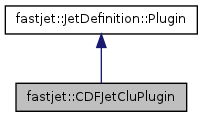
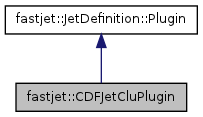
Implementation of the JetClu algorithm from CDF (plugin for fastjet-v2.1 upwards) More...
#include <CDFJetCluPlugin.hh>
Public Member Functions | |
| CDFJetCluPlugin (double cone_radius, double overlap_threshold, double seed_threshold=1.0, int iratch=1) | |
| a compact constructor | |
| CDFJetCluPlugin (double seed_threshold, double cone_radius, int adjacency_cut, int max_iterations, int iratch, double overlap_threshold) | |
| a constructor that looks like the one provided by CDF | |
| double | seed_threshold () const |
| double | cone_radius () const |
| int | adjacency_cut () const |
| int | max_iterations () const |
| int | iratch () const |
| double | overlap_threshold () const |
| virtual std::string | description () const |
| return a textual description of the jet-definition implemented in this plugin | |
| virtual void | run_clustering (ClusterSequence &) const |
| given a ClusterSequence that has been filled up with initial particles, the following function should fill up the rest of the ClusterSequence, using the following member functions of ClusterSequence: | |
| virtual double | R () const |
| the plugin mechanism's standard way of accessing the jet radius | |
Implementation of the JetClu algorithm from CDF (plugin for fastjet-v2.1 upwards)
Definition at line 46 of file CDFJetCluPlugin.hh.
| void fastjet::CDFJetCluPlugin::run_clustering | ( | ClusterSequence & | ) | const [virtual] |
given a ClusterSequence that has been filled up with initial particles, the following function should fill up the rest of the ClusterSequence, using the following member functions of ClusterSequence:
Implements fastjet::JetDefinition::Plugin.
Definition at line 61 of file CDFJetCluPlugin.cc.
References fastjet::ClusterSequence::jets(), fastjet::ClusterSequence::plugin_record_iB_recombination(), and fastjet::ClusterSequence::plugin_record_ij_recombination().
                                                                      {

  // create the physics towers needed by the CDF code
  vector<PhysicsTower> towers;
  towers.reserve(clust_seq.jets().size());

  // create a map to identify jets (actually just the input particles)...
  //map<double,int> jetmap;

  for (unsigned i = 0; i < clust_seq.jets().size(); i++) {
    PseudoJet particle(clust_seq.jets()[i]);
    //_insert_unique(particle, jetmap);
    LorentzVector fourvect(particle.px(), particle.py(),
                           particle.pz(), particle.E());
    PhysicsTower tower(fourvect);
    // add tracking information for later
    tower.fjindex = i;
    towers.push_back(tower);
  }

  // prepare the CDF algorithm
  JetCluAlgorithm j(seed_threshold(), cone_radius(), adjacency_cut(),
                    max_iterations(), iratch(), overlap_threshold());

  // run the CDF algorithm
  std::vector<Cluster> jets;
  j.run(towers,jets);


  // now transfer the jets back into our own structure -- we will
  // mimic the cone code with a sequential recombination sequence in
  // which the jets are built up by adding one particle at a time

  // NB: with g++-4.0, the reverse iterator code gave problems, so switch
  //     to indices instead
  //for(vector<Cluster>::const_reverse_iterator jetIter = jets.rbegin();
  //                                    jetIter != jets.rend(); jetIter++) {
  //  const vector<PhysicsTower> & tower_list = jetIter->towerList;
  //  int jet_k = jetmap[tower_list[0].fourVector.E];
  //
  //  int ntow = int(jetIter->towerList.size());

  for(int iCDFjets = jets.size()-1; iCDFjets >= 0; iCDFjets--) {

    const vector<PhysicsTower> & tower_list = jets[iCDFjets].towerList;
    int ntow = int(tower_list.size());

    // 2008-09-04: sort the towerList (according to fjindex) so as
    //             to have a consistent order for particles in jet
    //             (necessary because addition of ultra-soft particles
    //             sometimes often modifies the order, while maintaining
    //             the same overall set)
    vector<int>    jc_indices(ntow);
    vector<double> fj_indices(ntow); // use double: benefit from existing routine
    for (int itow = 0; itow < ntow; itow++) {
      jc_indices[itow] = itow;
      fj_indices[itow] = tower_list[itow].fjindex;
    }
    sort_indices(jc_indices, fj_indices);

    int jet_k = tower_list[jc_indices[0]].fjindex;

    for (int itow = 1; itow < ntow; itow++) {
      if (tower_list[jc_indices[itow]].Et() > 1e-50) {
      }
      int jet_i = jet_k;
      // retrieve our index for the jet
      int jet_j;
      jet_j = tower_list[jc_indices[itow]].fjindex;

      // safety check
      assert (jet_j >= 0 && jet_j < int(towers.size()));

      // do a fake recombination step with dij=0
      double dij = 0.0;

      // JetClu does E-scheme recombination so we can stick with the
      // simple option
      clust_seq.plugin_record_ij_recombination(jet_i, jet_j, dij, jet_k);

    }

    // NB: put a sensible looking d_iB just to be nice...
    double d_iB = clust_seq.jets()[jet_k].perp2();
    clust_seq.plugin_record_iB_recombination(jet_k, d_iB);
  }


  // following code is for testing only
  //cout << endl;
  //for(vector<Cluster>::const_iterator jetIter = jets.begin();
  //                                    jetIter != jets.end(); jetIter++) {
  //  cout << jetIter->fourVector.pt() << " " << jetIter->fourVector.y() << endl;
  //}
  //cout << "-----------------------------------------------------\n";
  //vector<PseudoJet> ourjets(clust_seq.inclusive_jets());
  //for (vector<PseudoJet>::const_iterator ourjet = ourjets.begin();
  //     ourjet != ourjets.end(); ourjet++) {
  //  cout << ourjet->perp() << " " << ourjet->rap() << endl;
  //}
  //cout << endl;
}
 1.7.4
1.7.4

