|
FastJet 3.0alpha3
|
|
FastJet 3.0alpha3
|
Class that helps perform filtering/trimming on jets, and optionally subtraction (if rho > 0). More...
#include <Filter.hh>
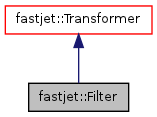
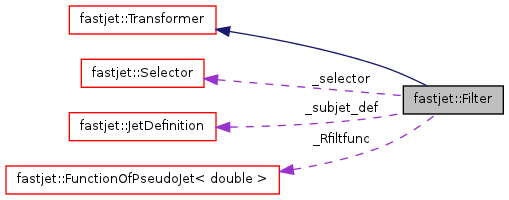
Public Types | |
| typedef FilterStructure | StructureType |
| information about the associated structure type | |
Public Member Functions | |
| Filter () | |
| trivial ctor Note: this is just for derived classes a Filter initialised through this constructor will not work! | |
| Filter (JetDefinition subjet_def, Selector selector, double rho=0.0) | |
| define a filter that decomposes a jet into subjets using a generic JetDefinition and then keeps only a subset of these subjets according to a Selector. | |
| Filter (double Rfilt, Selector selector, double rho=0.0) | |
| Same as the full constructor (see above) but just specifying the radius By default, Cambridge-Aachen is used. | |
| Filter (FunctionOfPseudoJet< double > *Rfilt_func, Selector selector, double rho=0.0) | |
| Same as the full constructor (see above) but just specifying a filtering radius that will depend on the jet being filtered As for teh previous case, Cambridge-Aachen is used. | |
| virtual | ~Filter () |
| default dtor | |
| virtual PseudoJet | result (const PseudoJet &jet) const |
| runs the filtering and sets kept and rejected to be the jets of interest (with non-zero rho, they will have been subtracted). | |
| virtual std::string | description () const |
| class description | |
Protected Member Functions | |
| void | _set_filtered_elements (const PseudoJet &jet, std::vector< PseudoJet > &filtered_elements) const |
| sets filtered_elements to be all the subjets on which filtering will work [NB: this routine is work in progress as part of a transition to a Filter that also works on jet collections] | |
| PseudoJet | _finalise (const PseudoJet &jet, std::vector< PseudoJet > &kept, std::vector< PseudoJet > &rejected) const |
| gather the information about what is kept and rejected under the form of a PseudoJet with a special ClusterSequenceInfo | |
| bool | _check_ca (const PseudoJet &jet) const |
| check if one can apply the simplified trick for C/A subjets | |
| bool | _recursively_check_ca (const PseudoJet &jet, std::vector< PseudoJet > &cumulative_pieces) const |
| check if the jet is obtained from C/A or a superposition of C/A pieces | |
| void | _set_filtered_elements_cafilt (const PseudoJet &jet, std::vector< PseudoJet > &filtered_elements, double Rfilt) const |
| set the filtered elements in the simple case of C/A+C/A | |
| void | _set_filtered_elements_generic_unsubtracted (const PseudoJet &jet, std::vector< PseudoJet > &filtered_elements) const |
| set the filtered elements in the generic re-clustering case (wo subtraction) | |
| void | _set_filtered_elements_generic_subtracted (const PseudoJet &jet, std::vector< PseudoJet > &filtered_elements) const |
| set the filtered elements in the generic re-clustering case (with subtraction) | |
Protected Attributes | |
| JetDefinition | _subjet_def |
| the jet definition to use to extract the subjets | |
| FunctionOfPseudoJet< double > * | _Rfiltfunc |
| a dynamic filtering radius function of the jet being filtered | |
| Selector | _selector |
| the subjet selection criterium | |
| double | _rho |
| the background density (used for subtraction when possible) | |
Class that helps perform filtering/trimming on jets, and optionally subtraction (if rho > 0).
Though the original version was applied on Cambridge/Aachen jets, this one takes any jet (that has constituents) and reclusters it with a given algorithm. A user-provided Selector is applied to decide which of the subjets are kept to produce the filtered jet (others are discarded).
The constructor has the following arguments:
Filtering as proposed in arXiv:0802.2470 for boosted object reconstruction (and used also in arXiv:0810.1304 for dijet reconstructions) involves two parameters, the filtering radius, Rfilt, and the number of subjets you wish to keep, nfilt. To get a filter of this kind define
Filter filter(JetDefinition(cambridge_algorithm,Rfilt), SelectorNHardest(nfilt));
You apply it as follows
PseudoJet filtered_jet = filter(jet);
To get trimming defined with respect to a jet's pt, arXiv:0912.1342, you need an Rtrim to define subjets and a pt_fraction_min to decide which subjets to keep:
Filter trimmer(JetDefinition(cambridge_algorithm,Rfilt), SelectorPtFractionMin(pt_fraction_min));
You then apply it as before
PseudoJet trimmed_jet = trimmer(jet);
You can then find out which pieces were filtered or trimmed jet is made of by calling
trimmed_jet.pieces()
Trimming defined with respect to an event's effective mass can be carried out with a SelectorPtMin(...) selector.
More sophisticated filters/trimmers can easily be obtained by combining Selectors.
[MORE INFO, E.G. ON PIECES REJECTED, SHOULD FOLLOW]
If the jet was defined with the cambridge/aachen algorithm (or is made of pieces each of which comes from the C/A alg) and the filtering definition is C/A, then the filter does not rerun the C/A algorithm on the constituents, but instead makes use of the existent C/A cluster sequence in the original jet.
See also 12 - use of filtering for a usage example.
| fastjet::Filter::Filter | ( | JetDefinition | subjet_def, |
| Selector | selector, | ||
| double | rho = 0.0 |
||
| ) | [inline] |
define a filter that decomposes a jet into subjets using a generic JetDefinition and then keeps only a subset of these subjets according to a Selector.
Optionally, each subjet may be internally bakground-subtracted prior to selection.
| subjet_def | the jet definition applied to obtain the subjets |
| selector | the Selector applied to compute the kept subjets |
| rho | if non-zero, backgruond-subtract each subjet befor selection |
Note: internal subtraction only applies on jets that are obtained with a cluster sequence with area support and explicit ghosts
Definition at line 154 of file Filter.hh.
                                                                        :
    _subjet_def(subjet_def), _Rfiltfunc(0), _selector(selector), _rho(rho) {}
| fastjet::Filter::Filter | ( | double | Rfilt, |
| Selector | selector, | ||
| double | rho = 0.0 |
||
| ) | [inline] |
Same as the full constructor (see above) but just specifying the radius By default, Cambridge-Aachen is used.
| Rfilt | the filtering radius |
Definition at line 160 of file Filter.hh.
References fastjet::cambridge_algorithm.
                                                            :
    _subjet_def(JetDefinition(cambridge_algorithm, Rfilt)),
    _Rfiltfunc(0), _selector(selector), _rho(rho) {}
| fastjet::Filter::Filter | ( | FunctionOfPseudoJet< double > * | Rfilt_func, |
| Selector | selector, | ||
| double | rho = 0.0 |
||
| ) | [inline] |
Same as the full constructor (see above) but just specifying a filtering radius that will depend on the jet being filtered As for teh previous case, Cambridge-Aachen is used.
| Rfilt_func | the filtering radius function of a PseudoJet |
Definition at line 168 of file Filter.hh.
                                                                                       :
    _Rfiltfunc(Rfilt_func), _selector(selector), _rho(rho) {}
runs the filtering and sets kept and rejected to be the jets of interest (with non-zero rho, they will have been subtracted).
| jet | the jet that gets filtered |
Implements fastjet::Transformer.
Definition at line 62 of file Filter.cc.
                                                   {
  // start by getting the list of subjets (including a list of sanity
  // checks)
  // NB: subjets is empty to begin with (see the comment for
  //     _set_filtered_elements_cafilt)
  vector<PseudoJet> subjets;
  _set_filtered_elements(jet, subjets);

  // now build the vector of kept and rejected subjets
  vector<PseudoJet> kept, rejected;
  // Note that the following line is the one requiring that _selector
  // be declared as mutable
  if (_selector.takes_reference()) _selector.set_reference(jet);
  _selector.sift(subjets, kept, rejected);

  // gather the info under the form of a PseudoJet
  return _finalise(jet, kept, rejected);
}
 1.7.4
1.7.4

