|
FastJet 3.0alpha3
|
|
FastJet 3.0alpha3
|
Implementation of the PxCone algorithm (plugin for fastjet v2.1 upwards) More...
#include <PxConePlugin.hh>
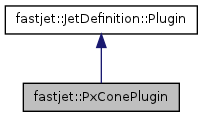
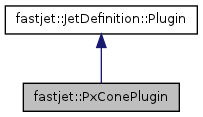
Public Member Functions | |
| PxConePlugin (double cone_radius, double min_jet_energy=5.0, double overlap_threshold=0.5, bool E_scheme_jets=false) | |
| constructor for the PxConePlugin, whose arguments have the following meaning: | |
| double | cone_radius () const |
| the cone radius | |
| double | min_jet_energy () const |
| minimum jet energy (protojets below this are thrown own before merging/splitting) -- called epslon in pxcone | |
| double | overlap_threshold () const |
| Maximum fraction of overlap energy in a jet -- called ovlim in pxcone. | |
| bool | E_scheme_jets () const |
| if true then the final jets are returned as the E-scheme recombination of the particle momenta (by default, pxcone returns massless jets with a mean phi,eta type of recombination); regardless of what is returned, the internal pxcone jet-finding procedure is unaffected. | |
| virtual std::string | description () const |
| return a textual description of the jet-definition implemented in this plugin | |
| virtual void | run_clustering (ClusterSequence &) const |
| given a ClusterSequence that has been filled up with initial particles, the following function should fill up the rest of the ClusterSequence, using the following member functions of ClusterSequence: | |
| virtual double | R () const |
| the plugin mechanism's standard way of accessing the jet radius | |
Implementation of the PxCone algorithm (plugin for fastjet v2.1 upwards)
PxConePlugin is a plugin for fastjet (v2.1 upwards) that provides an interface to the fortran pxcone iterative cone algorithm with midpoint seeds.
Pxcone was written by Luis del Pozo and Michael H. Seymour. It is not a "supported" program, so if you encounter problems, you are on your own...
Note that pxcone sometimes encounters non-stable iterations; in such cases it returns an error -- the plugin propagates this by throwing a fastjet::Error exception; if the user wishes to have robust code, they should catch this exception.
Pxcone has a hard-coded limit (by default 4000) on the maximum number of particles and protojets; if the number of particles or protojets exceeds this, again a fastjet::Error exception will be thrown.
The functionality of pxcone is described at http://www.hep.man.ac.uk/u/wplano/ConeJet.ps
Definition at line 68 of file PxConePlugin.hh.
| fastjet::PxConePlugin::PxConePlugin | ( | double | cone_radius, |
| double | min_jet_energy = 5.0, |
||
| double | overlap_threshold = 0.5, |
||
| bool | E_scheme_jets = false |
||
| ) | [inline] |
constructor for the PxConePlugin, whose arguments have the following meaning:
Definition at line 92 of file PxConePlugin.hh.
                                               :
    _cone_radius        (cone_radius        ),
    _min_jet_energy     (min_jet_energy     ),
    _overlap_threshold  (overlap_threshold  ),
    _E_scheme_jets      (E_scheme_jets      ) {}
| bool fastjet::PxConePlugin::E_scheme_jets | ( | ) | const [inline] |
if true then the final jets are returned as the E-scheme recombination of the particle momenta (by default, pxcone returns massless jets with a mean phi,eta type of recombination); regardless of what is returned, the internal pxcone jet-finding procedure is unaffected.
Definition at line 119 of file PxConePlugin.hh.
{return _E_scheme_jets ;}
| void fastjet::PxConePlugin::run_clustering | ( | ClusterSequence & | ) | const [virtual] |
given a ClusterSequence that has been filled up with initial particles, the following function should fill up the rest of the ClusterSequence, using the following member functions of ClusterSequence:
Implements fastjet::JetDefinition::Plugin.
Definition at line 58 of file PxConePlugin.cc.
References fastjet::ClusterSequence::jets(), fastjet::ClusterSequence::plugin_record_iB_recombination(), and fastjet::ClusterSequence::plugin_record_ij_recombination().
                                                                   {

  // only have hh mode
  int mode = 2;

  int    ntrak = clust_seq.jets().size(), itkdm = 4;
  double *ptrak = new double[ntrak*4+1];
  for (int i = 0; i < ntrak; i++) {
    ptrak[4*i+0] = clust_seq.jets()[i].px();
    ptrak[4*i+1] = clust_seq.jets()[i].py();
    ptrak[4*i+2] = clust_seq.jets()[i].pz();
    ptrak[4*i+3] = clust_seq.jets()[i].E();
  }

  // max number of allowed jets
  int mxjet = ntrak;
  int njet;
  double *pjet  = new double[mxjet*5+1];
  int    *ipass = new int[ntrak+1];
  int    *ijmul = new int[mxjet+1];
  int ierr;

  // run pxcone
  pxcone(
    mode   ,    // 1=>e+e-, 2=>hadron-hadron
    ntrak  ,    // Number of particles
    itkdm  ,    // First dimension of PTRAK array:
    ptrak  ,    // Array of particle 4-momenta (Px,Py,Pz,E)
    cone_radius()  ,    // Cone size (half angle) in radians
    min_jet_energy() ,    // Minimum Jet energy (GeV)
    overlap_threshold()  ,    // Maximum fraction of overlap energy in a jet
    mxjet  ,    // Maximum possible number of jets
    njet   ,    // Number of jets found
    pjet ,       // 5-vectors of jets
    ipass,      // Particle k belongs to jet number IPASS(k)-1
                // IPASS = -1 if not assosciated to a jet
    ijmul,      // Jet i contains IJMUL[i] particles
    ierr        // = 0 if all is OK ;   = -1 otherwise
    );

  if (ierr != 0) throw Error("An error occurred while running PXCONE");

  // now transfer information back
  valarray<int> last_index_created(njet);

  vector<vector<int> > jet_particle_content(njet);

  // get a list of particles in each jet
  for (int itrak = 0; itrak < ntrak; itrak++) {
    int jet_i = ipass[itrak] - 1;
    if (jet_i >= 0) jet_particle_content[jet_i].push_back(itrak);
  }

  // now transfer the jets back into our own structure -- we will
  // mimic the cone code with a sequential recombination sequence in
  // which the jets are built up by adding one particle at a time
  for(int ipxjet = njet-1; ipxjet >= 0; ipxjet--) {
    const vector<int> & jet_trak_list = jet_particle_content[ipxjet];
    int jet_k = jet_trak_list[0];

    for (unsigned ilist = 1; ilist < jet_trak_list.size(); ilist++) {
      int jet_i = jet_k;
      // retrieve our misappropriated index for the jet
      int jet_j = jet_trak_list[ilist];
      // do a fake recombination step with dij=0
      double dij = 0.0;
      //clust_seq.plugin_record_ij_recombination(jet_i, jet_j, dij, jet_k);
      if (ilist != jet_trak_list.size()-1 || E_scheme_jets()) {
        // our E-scheme recombination in cases where it doesn't matter
        clust_seq.plugin_record_ij_recombination(jet_i, jet_j, dij, jet_k);
      } else {
        // put in pxcone's momentum for the last recombination so that the
        // final inclusive jet corresponds exactly to PXCONE's
        clust_seq.plugin_record_ij_recombination(jet_i, jet_j, dij,
                                PseudoJet(pjet[5*ipxjet+0],pjet[5*ipxjet+1],
                                          pjet[5*ipxjet+2],pjet[5*ipxjet+3]),
                                                 jet_k);
      }
    }

    // NB: put a sensible looking d_iB just to be nice...
    double d_iB = clust_seq.jets()[jet_k].perp2();
    clust_seq.plugin_record_iB_recombination(jet_k, d_iB);
  }


  //// following code is for testing only
  //cout << endl;
  //for (int ijet = 0; ijet < njet; ijet++) {
  //  PseudoJet jet(pjet[ijet][0],pjet[ijet][1],pjet[ijet][2],pjet[ijet][3]);
  //  cout << jet.perp() << " " << jet.rap() << endl;
  //}
  //cout << "-----------------------------------------------------\n";
  //vector<PseudoJet> ourjets(clust_seq.inclusive_jets());
  //for (vector<PseudoJet>::const_iterator ourjet = ourjets.begin();
  //     ourjet != ourjets.end(); ourjet++) {
  //  cout << ourjet->perp() << " " << ourjet->rap() << endl;
  //}
  ////cout << endl;

  delete[] ptrak;
  delete[] ipass;
  delete[] ijmul;
  delete[] pjet;
}
 1.7.4
1.7.4

