|
FastJet 3.0alpha3
|
|
FastJet 3.0alpha3
|
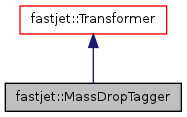
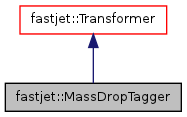
Class that helps perform 2-pronged boosted tagging using the "mass-drop" technique. More...
#include <MassDropTagger.hh>
Public Types | |
| typedef MassDropStructure | StructureType |
| the type of the associated structure | |
Public Member Functions | |
| MassDropTagger (const double mu=0.67, const double ycut=0.09) | |
| default ctor | |
| virtual std::string | description () const |
| description of the tagger | |
| virtual PseudoJet | result (const PseudoJet &jet) const |
| the tagging itself | |
Protected Attributes | |
| double | _mu |
| double | _ycut |
Class that helps perform 2-pronged boosted tagging using the "mass-drop" technique.
This implements the boosted Higgs tagger introduced by Jonathan Butterworth, Adam Davison, Mathieu Rubin and Gavin Salam in arXiv:0802.2470.
The tagger proceeds as follows:
0. start from a jet obtained from with the Cambridge/Aachen algorithm
1. undo the last step of the clustering step j -> j1 + j2 (label them such as j1 is the most massive).
2. if there is a mass drop, i.e. m_j1/m_j < mu_cut, and the splitting is sufficiently symmetric,  , keep j as the result of the tagger (with j1 and j2 its 2 subjets)
3. otherwise, redefine j to be equal to j1 and return to step 1.
Note that in the original proposal, j1 and j2 were both required to be b-tagged and a filter (with Rfilt=min(0.3,Rbb/2) and n_filt=3) was applied to j to obtain the final "Higgs candidate". This filtering technique can always be done by defining a FunctionOfPseudoJet to compute dynamically Rfilt and then use the Filter RfiltDyn rfilt; Filter final_filter(&rfilt, SelectorNHardest(3)); See the filter example to see explicitly how this can be done.
The constructor has the following arguments:
Definition at line 98 of file MassDropTagger.hh.
the tagging itself
| jet | the PseudoJet to tag |
Implements fastjet::Transformer.
Definition at line 54 of file MassDropTagger.cc.
References fastjet::PseudoJet::associated_cluster_sequence(), fastjet::PseudoJet::has_parents(), fastjet::ClusterSequence::jet_def(), fastjet::PseudoJet::kt_distance(), fastjet::PseudoJet::m(), fastjet::PseudoJet::m2(), fastjet::JetDefinition::recombiner(), and fastjet::PseudoJet::structure_non_const_ptr().
                                                           {
  PseudoJet j = jet;
  PseudoJet j1, j2;
  bool had_parents;

  // we just ask that we can "walk" in the cluster sequence.
  // appropriate errors will be thrown automatically if this is not
  // the case
  while ((had_parents = j.has_parents(j1,j2))) {
    // make parent1 the more massive jet
    if (j1.m() < j2.m()) std::swap(j1,j2);

    // if we pass the conditions on the mass drop and its degree of
    // asymmetry (kt_dist/m^2 > rtycut [where kt_dist/m^2 \sim
    // z/(1-z)), then we've found something interesting, so exit the
    // loop
    if ( (j1.m() < _mu*j.m()) && (j1.kt_distance(j2) > _ycut*j.m2()) )
      break;
    else
      j = j1;
  }

  if (!had_parents)
    // no Higgs found, return an empty PseudoJet
    return PseudoJet();

  // create the result and its structure
  const JetDefinition::Recombiner *rec
    = jet.associated_cluster_sequence()->jet_def().recombiner();
  PseudoJet result = join<MassDropStructure>(j1,j2,*rec);
  MassDropStructure * s = (MassDropStructure *) result.structure_non_const_ptr();
  s->_mu = (j.m()!=0.0) ? j1.m()/j.m() : 0.0;
  s->_y  = (j1.m2()!=0.0) ? j1.kt_distance(j2)/j.m2() : 0.0;

  return result;
}
 1.7.4
1.7.4

